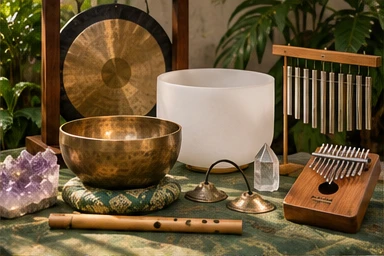
Understanding sound
How to play a singing bowl: striking, rim playing and listening
Begin with a light strike and listen to the whole decay. Rim playing is a separate technique that uses steady movement around the bowl’s edge rather than repeated tapping.
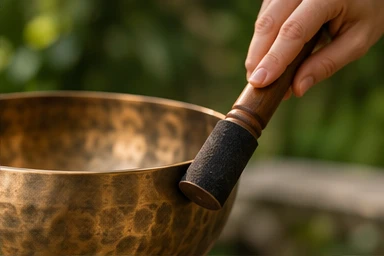
Set up a stable place
For a physical bowl, use a stable surface and a support appropriate to the instrument. Follow the maker’s guidance and protect the surface underneath. Give yourself room to move the mallet without hitting another object.
Begin at a modest volume. The aim of your first practice is to hear how the bowl responds, not to make the loudest sound possible. If you are learning with a facilitator, ask them to demonstrate how they support that particular bowl.
Try one gentle strike
Use the mallet intended for the bowl and make a light, controlled contact. Let the sound continue before playing again. Listen for the initial attack, the sustained tone and the quieter tail. Repeating this slowly helps you notice differences between strikes.
If you dislike the sharpness of the sound, ask about a softer mallet, a lighter touch or a different instrument. More force is not a useful answer to every playing difficulty.
Explore the rim separately
Move around the rim with a steady, controlled motion and enough consistent contact for that bowl and mallet. Ask an instructor to check the angle and pressure if the movement feels awkward. Physical bowls differ, so a universal speed or pressure rule is not reliable.
Avoid chasing an immediate result by pressing harder and moving faster at once. Change one aspect at a time, then listen. A short lesson can be more useful than buying additional bowls before you understand the one you have.
Try the digital version
On this site, tap a bowl to strike it. To build sustained sound, hold near the rim and move in a coherent circle; a straight swipe is not the same gesture. You can also choose autoplay to listen to layered phrases.
The digital model is an approximation. A phone screen does not reproduce the touch, weight or acoustic behaviour of a physical instrument. Use it to explore timing and listening, then ask a practitioner for hands-on guidance if you want to work with real bowls.
Will playing a digital bowl teach physical mallet pressure?
No. Digital gestures can introduce timing and listening, but they do not reproduce the contact mechanics of a real bowl and mallet.